
The 30th FilmFestival Cottbus - start of the online anniversary edition
The 30th FilmFestival Cottbus begins on Tuesday, 8 December 2020. For more than three weeks - until 31 December - the anniversary edition will present 150 films nationwide in stream. In addition to the film programme, the FFC offers an online Q&A-programme with talks with film-makers as well as live talk rounds.
The festival will kick off with an opening show hosted by Nadine Heidenreich and the award-winning short film MASEL TOV COCKTAIL by Arkadij Khaet and Mickey Paatzsch - both films will be available as live streams on 8 December 2020, starting at 7 pm online via the FFC website, the festival's YouTube and Facebook channels. At the same time, the FFC will project the opening programme in public space at the Cottbus Stadthaus (at Erich Kästner Platz) onto the side wall of the Agentur für Arbeit. There it will be shown until 10 pm in a continuous loop next to the premiere of the art action "ArtFrontale - Künstlerhäuser für Cottbus", where works by Cottbus artist Hans Scheuerecker will be presented.
"After we have rescheduled and postponed several times, always with the aim of being able to present our programme in Cottbus cinemas, we are pleased that it is finally starting - even if exclusively digital. The anticipation of the premiere of the first completely digital FFC, on its 30th birthday of all times, is far outweighed by the melancholy," says Andreas Stein, managing director of the FFC’s organiser pool production. "Festivals will remain places of real encounters in the future, yet this edition also marks the dawn of a new festival age for us. We would like to thank all our supporters and sponsors who have helped us on this particularly rocky road this year".
Under "30th FFC #digital" the FilmFestival Cottbus bundles the additional offers of its first online edition. In the digital space, interested parties can enjoy the festival feeling thanks to additional offers that complement the film programme. Talks with filmmakers, panels, panel discussions and talk rounds with filmmakers, representatives from the fields of culture, science and politics provide insights into the film industry as well as historical, cultural and political contexts of the film programme.
"Our digital offers add a new dimension to the FilmFestival Cottbus. The live experience in the cinema will be cancelled this year, but new possibilities will take its place," explains FFC programme director Bernd Buder. "We are nevertheless retaining our established material. For example, the FFC audience can look forward to Q&A's with filmmakers on each of the works from the feature film competition and numerous contributions from the other sections. At "30th FFC #digital", FFC guests can expect an entertaining and exciting programme that complements the film experience very well in terms of content".
All talk formats will be broadcast on the YouTube channel of the FilmFestival Cottbus (www.youtube.com/FilmFestivalCottbus ) and will be continuously updated until the end of December.
Announcement of dates: The winners of the 30th FilmFestival Cottbus will be announced on Saturday, 12 December 2020 during an online award ceremony.
Information about FFC tickets
The streaming offer of the 30th FilmFestival Cottbus is available from 8 to 31 December 2020 on the festival website www.filmfestivalcottbus.de . Tickets can be booked via the respective film entry. The films are in their original language, optionally German or English subtitles are available. As there is a limited contingent of tickets for the films offered online, it is recommended to book in time.
About the FilmFestival Cottbus
The 30th FilmFestival Cottbus will take place in a nationwide online format: from 8 to 31 December 2020. In four competitions and numerous side sections, the FFC will show approximately 150 films competing for prizes with a total value of 72,000 Euros and the prestigious sculpture prize LUBINA (Sorbian: the Lovely). For the first time, not only the laureates of the Feature Film Competition, but also the winners of the Short Film and the U18 Youth Film Competitions, will be honoured with the LUBINAs. Over 22,000 spectators have visited the Festival of Eastern European Film in Cottbus over the last few years.
The 30th FFC is significantly supported by the State of Brandenburg, the Medienboard Berlin-Brandenburg GmbH, the City of Cottbus, the German Foreign Office and the Creative Europe MEDIA Program of the European Union.
Eastern Europe nationwide - the 30th FilmFestival Cottbus shows its programme in a stream

As the Federal Government and the German States extended the measures aimed at combating the coronavirus pandemic on the 25.11.2020 and cinemas will also remain closed, therefore, the film screenings of the 30th FilmFestival Cottbus planned between the 8th and 13th December 2020 in the cinemas cannot take place. Nevertheless, from 8 to 31 December 2020, 150 films will be available as a nationwide streaming offer on the festival website.
"The health of our visitors from near and far is our top priority in the times of pandemic. As regrettable as the cancellation of our physical anniversary festival is for us, the more are we pleased about an extensive digital offer with 150 films and further content in a stream - via our website and with our partner Pantaflix, in a live stream on our YouTube channel and via our social media channels", emphasises Andreas Stein, managing director of the FFC’s organiser pool production. "After initially postponing the 30th FilmFestival Cottbus, which was planned in a dual form, - in the hope of being able to take place with face-to-face events after all - we will not postpone the festival again, but instead, we will put all our energy into the digital realisation of the festival".
The FFC’s programme director Bernd Buder adds: "Our nationwide streaming offer, available via the festival website, offers a very special opportunity to get to know, rediscover and enjoy Eastern European cinema. We show the films from the 15 programme sections in their original language and provide either German or English subtitles."
In addition to the film programme, talks with filmmakers, panel discussions and talk rounds with representatives from the fields of culture, science and politics will provide an insight into the film industry as well as the historical, cultural and political context of the film programme.
All talk formats will be broadcast on the YouTube channel of the FilmFestival Cottbus (www.youtube.com/FilmFestivalCottbus).
Information on the FFC tickets
The streaming offer of the 30th FilmFestival Cottbus will be available on the festival website from 8 to 31 December 2020. Tickets can be booked through the respective film entry link. The films are streamed in their original language version, optionally German or English subtitles are available. As there is a limited contingent of tickets for the films offered online, it is recommended to book them in good time.
The tickets for the streaming offer that have been already booked, remain valid. Rented films can be watched as often as desired within the 24 hours after the first start of the film. The film starts by entering the ID number of the previously purchased ticket.
The FilmFestival Cottbus would like to thank its sponsors and partners, who have stood by the festival even in these difficult conditions. Special thanks go to the Land Brandenburg, Medienboard Berlin-Brandenburg GmbH, the city of Cottbus, Creative Europe – MEDIA and the Federal Foreign Office.
In addition, we would like to thank the Gesellschaft zur Wahrnehmung von Film- und Fernsehrechten (GWFF), Big Cinema, the Sparkasse Spree-Neiße and the Gebäudewirtschaft Cottbus, the Federal Government Commissioner for Culture and the Media, the Bundesstiftung zur Aufarbeitung der SED-Diktatur, the Bundeszentrale für politische Bildung, the Investitionsbank des Landes Brandenburg, the Stiftung für das sorbische Volk, the Stiftung für deutsch-polnische Zusammenarbeit, the Deutsch-Tschechischer Zukunftsfond, the Rosa-Luxemburg-Stiftung as well as all our other loyal partners and supporters and our media partners.
About the FilmFestival Cottbus
The 30th FilmFestival Cottbus will take place in a nationwide online format: from December 8th to 31st, 2020. In four competitions and numerous side sections, the FFC will show approximately 150 films competing for prizes with a total value of 72,000 Euros and the prestigious sculpture prize LUBINA (Sorbian: the Lovely). For the first time, not only the laureates of the Feature Film Competition, but also the winners of the Short Film and the U18 Youth Film Competitions, will be honoured with the LUBINAs. Over 22,000 spectators have visited the Festival of Eastern European Film in Cottbus over the last few years.
IN TOUCH – Online film screening and discussion
On October 28th, 18.15
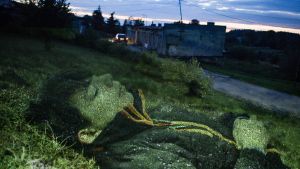
the project "Ukraine Calling" will show the Polish documentary film IN TOUCH, an experimental reflection on the relationship between labour migrants and their "home-bound" parents and grandparents. In this case of the Masurian village Stare Juchy, from which one third of the inhabitants moved to Iceland. The online screening will be followed by a discussion with the director Paweł Ziemilski and Bernd Buder, programme director of the FilmFestival Cottbus.
IN TOUCH was screened at the FilmFestival Cottbus 2019 in the section "Polskie Horyzonty".
Weitere Informationen zur Veranstaltung und Anmeldung unter: www.ukrainecalling.eu/events/communication-in-one-touch/ oder bei der Facebook-Veranstaltung.
„Ukraine Calling“
is a project-oriented capacity building measure for organisations from Ukraine, France, Poland, and Germany. Through seminars and workshops, the programme will provide orientational and applied knowledge on the topics of migration (in 2020) and local development (in 2021), as well as foster cross-sectoral competences and transnational networking.
Subsequently, the participants from various fields (education, human rights, culture and others) will implement their project ideas and establish new cooperations, contributing to a sustainable transnational dialogue.
Frequently asked questions to the 30th FFC

Here are the answers!
Ticketing, streaming, Corona? In our FAQs you can find out everything about the schedule, form and other details of the dual FilmFestival Cottbus.
THIS WAY PLEASE!
Film Location Brandenburg: From „Inglourious Basterds“ to the double Schönborn
Under the title "Film Location Brandenburg", the 30th FFC will be exploring the state of Brandenburg, which celebrates the 30th anniversary of its founding on 3 October, as an extremely versatile film location for international and German productions from 3 to 8 November.
Every year dozens of feature films and television series are produced in Brandenburg. Not only in Potsdam-Babelsberg, but also in the surrounding area: from the Havelland to the Oderbruch, from the Uckermark to Lusatia, (inter)national film productions benefit from very diverse landscapes and good infrastructure, and use the creative resources, skilled workers and service providers located in the region. Shoots for INGLOURIOUS BASTERDS are legendary in Rüdersdorf and Nauen, where Quentin Tarantino had a French tavern built. For TOM SAWYER, Trebelsee in Ketzin became the Mississippi, the journey of Tilda and her demented grandfather Amandus in Til Schweiger's HEAD FULL OF HONEY led through the Prignitz, and the two West German brothers Rudi and Moritz stranded in the village pub of Grüntal in the Barnim in Detlev Buck's cult satire NO MORE MR. NICE GUY.
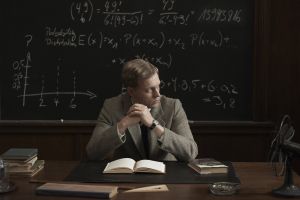
For the German-Polish co-production ADVENTURES OF A MATHEMATICIAN, which is celebrating its European premiere at the FFC, the US nuclear weapons development centre Los Alamos was reconstructed at the former Cottbus-Drewitz airport. The open-cast mines in the Lusatian lignite mining area have repeatedly served as backdrops for desert and science fiction films, and the dilapidated hospital complex of Beelitz-Heilstätten as a morbid setting for historical events.In "Drehort Brandenburg", the FFC shows films for which Brandenburg served as the background, from the Oscar candidate BARBARA to the documentary film SCHÖNBORN, a portrait of two different villages with the same name: Schönborn in the Elbe-Elster district and Schönborn in Transcarpathia in Ukraine.
The Project "Drehort Brandenburg (Film Location Brandenburg)" is supported by the State Office of the State of Brandenburg.
Von Frust und Freiheit (Of Frustration and Freedom) – History of the post-reunification period
The 30th year of German unification marks a change not only for Germany but also for its neighbouring countries. The FFC section "Von Frust und Freiheit" (Of Frustration and Freedom) - History(s) of the Post-Revolutionary Era looks at the effects in (East) Germany and the former socialist states of East Central Europe– Poland, Hungary, Slovakia and the Czech Republic. The works presented tell astonishingly colourful stories of a border region that is growing together, influenced on both sides from a spirit of new beginnings and resignation.
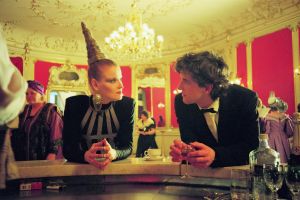
The focus is on people, their hopes and disappointments. They tell of new self-determination and determination by others, of social awakening and resignation - of frustration and freedom. The films in the series look at personal careers and biographical breaks and breakdowns, demonstrate opportunities, challenges and failures in the transformation process. The spectrum ranges from rediscoveries from the 1990s, such as the brightly coloured, over-excited musical DON GIO (Czechoslovakia 1992), in which capitalism, a few moments after the opening of the Iron Curtain, attacks a provincial theatre and actually the whole country like a predator, to the Hungarian cult film JUNK MOVIE, and BORDERLAND. In his latest film, Andreas Voigt, the great documentary filmmaker of the East, travels again to the border region between Germany, Poland and the Czech Republic 28 years after the release of his documentary classic "Grenzland - eine Reise". On the Oder and Neisse rivers he even meets protagonists from back then again. These encounters tell of the hopes and disappointments of a society in which some have resigned themselves and others have dared to take off.
Produced between 1990 and 2020, ten feature films and documentaries as well as a short film programme of the series "Von Frust und Freiheit (Of Frustration and Freedom)"- most of which will be presented at the FFC - show very different perspectives on the developments of the past three decades. Until the end of the year, the film series will be touring in Germany and will also be shown in Poland and the Czech Republic.
The series „Von Frust und Freiheit“ (Of Frustration and Freedom) is supported by Bundesstiftung zur Aufarbeitung der SED-Diktatur.
„Stau 1990/2020“: Right-wing extremism as a side effect of the reunification process
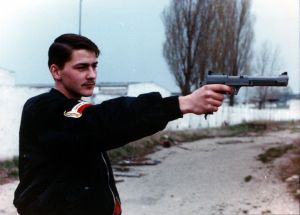
With the series "Stau 1990/2020", the 30th FilmFestival Cottbus, on the occasion of the 30th anniversary of German Unity, reflects on the right-wing extremism of the 1990s as an anti-democratic side effect of the reunification process and asks about the consequences for the current political culture.
In the 1990s, the influx of right-wing extremist parties and right-wing subcultures was one of the side effects of the reunification process in eastern Germany. As it is today, the "New Right" was striving at that time for a sovereignty of interpretation on certain issues, and similar to today, youth subcultures played a leading role "on the streets". In the last years of the GDR and shortly after the "Wende", criminologists and filmmakers explored a topic that did not fit into the official image of socialism and was played down as "hooliganism".
After reunification, violent assaults increased, always with serious, often fatal consequences for the victims. The attacks on the dormitories in Hoyerswerda, Wittenberge and Rostock-Lichtenhagen stand for sad lows in the history of the reunification – like the hunt for foreigners in Chemnitz or the attack on the synagogue in Halle today.
The series "Stau 1990/2020" goes back to the 1990s, takes a look at documentary classics such as UNSERE KINDER and STAU - JETZT GEHT'S LOS. Together with filmmakers such as Thomas Heise and Pablo Ben-Yakov (LORD OF THE TOYS) as well as contemporary witnesses and experts such as Cottbus social worker Barbara Domke and Berlin detective Bernd Wagner, the FFC asks what long-term effect the "baseball bat years" have had on the ongoing brutalisation and threat to political culture in East Germany from the right-wing extremists.
The "Stau 1190/2020" series is supported by Bundesstiftung zur Aufarbeitung der SED-Diktatur.
FFC at the Finále Plzeň
For three years now, the FFC has been presenting programmes of German films at the Finále Pilsen, the most important national Czech film festival. This year, under the title "30 years after the fall of the Iron Curtain", the programme includes eight feature films, documentaries and short films that deal with East-West German themes in a pointed way.
They deal with the difficulties and the courage to overcome physical and psychological borders - from arduous small family trips from Germany to the Czech Republic (BABYLON, NOTHING MORE PERFECT) to a childhood experience during the fall of the Wall (DRÜBENLAND – THE LAND OVER THERE), a psycho-thriller about two friends, between whom a Stasi suspicion exists (TO THE STARS) to Daniel Abma's long-term observation of a legendary road construction site, which for decades paralysed fast traffic between Amsterdam and Warsaw (MOTORWAY). Also included is Dirk Lienig's Hoyerswerda portrait ONCE WE ARE DANCING, which premiered at the FFC in 2018.
TO THE STARS and NOTHING MORE PERFECT will be screened at this year’s edition of the FFC. Due to the Covid19 pandemic, Finále Pilsen was moved from April to September 25-30. The "Czech Film Springboard", a film industry network meeting where new Czech feature film projects are presented and discussed by experts, is taking place online in parallel. Bernd Buder, programme director of the FFC, joins on the lookout for new films for the festival programme.
More information: www.festivalfinale.cz/eng/news/detail?idZprava=186
And: www.filmcenter.cz/en/news/1715-czech-film-springboard-2020
Student Encounter 2019
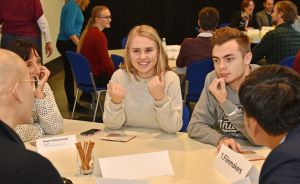
Film festivals are an excellent place for encounters and intercultural exchange between filmmakers and their audiences. Films can point to current narratives and it is not unusual for political and historical taboos to regain more public attention on the screen. They therefore offer an opportunity for joint reflection. Thus it is more than necessary to involve a young, multinational audience in this dialogue.
The FilmFestival Cottbus is organising a German-Polish and a German-Czech Youth Exchange for the fourth time and invites around 40 young people from the Czech Republic, Poland and Germany to the Cottbus cinemas. Together the students will watch films that deal with the realities of young people's lives today, but also with other relevant historical and current topics. In conversations, the young people question their context and cinematic approaches. For example, films from the regional portrait Lower Silesia are used to sensitise the young people for cases of fate in history, such as the consequences of the various forced resettlements after the Second World War, the new beginnings associated with them and the history of German-Polish reconciliation. They will then discuss the films shown, their themes and their artistic and dramaturgical implementation in discussions with filmmakers and experts.
On the occasion of the 30th anniversary of the fall of the Berlin Wall, special attention will be paid to a topic that has so far received little attention in contemporary historical research: the recruitment of minors by the Stasi. The documentary film STASI KIDS gathers contemporary witness interviews on this topic from Germany and the GDR. Often it was young people who were recruited by the secret service - was the double role as agent "cool", or was the pressure too big? Experiences that some of the contemporary witnesses from the film subsequently discuss personally with the young audience.
The Youth Exchange is organised by the Verein für Film- und Medienpädagogik Cottbus e.V. (Association for Film and Media Pedagogy Cottbus) under the title "German-Polish Student Exchange in Cottbus: Reflecting Film and Everyday Life Across Borders", supported by the Euroregion Spree-Neiße-Bober, in cooperation with the FilmFestival Cottbus, which thus once again becomes a place of intercultural media education. The three-day youth encounter will continue to be supported by the German Cultural Forum Eastern Europe.
Vice Chancellor Olaf Scholz supports the 29th FilmFestival Cottbus as Patron
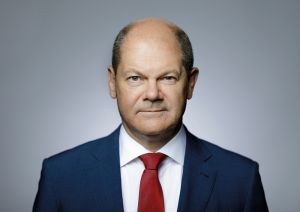
The FilmFestival Cottbus presents its complete programme, which this year includes 210 films from 45 (co)producing countries. With the Georgian film GORI | PIG by Giga Liklikadze, the FFC presents another world premiere in the Feature Film Competition. Patrons of the 29th edition of the FilmFestival Cottbus are Olaf Scholz, Vice Chancellor and Federal Minister of Finance, and traditionally Dietmar Woidke, Minister President of Brandenburg.
"The end of the so-called Iron Curtain was the beginning of the FilmFestival Cottbus, which since 1991 has developed into one of the world's leading festivals of East European cinema. Since then, the films of the 29 editions have also reflected the enormous transformation in the East European states. They take us into the reality of life on site. And let us feel through their characters what change means for each and every individual“, says Olaf Scholz, Vice Chancellor and Federal Minister of Finance, patron of the 29th FilmFestival Cottbus.
FEATURE FILM COMPETITION
In particular the 29th FFC's Feature Film Competition shows this reality of life and change – in the most unusual places, with a lot of emotion and a multitude of genres.
The coming-of-age story TOPAL ŞÜKRAN'IN MACERALARI | THE ADVENTURES OF SUKRAN THE LAME (2019) by Onur Ünlü is brightly coloured, in silent film format, cheeky and subversive. The first Turkish competition entry in the history of the FFC challenges: After an accident Sukran has to master her young life with a stiff leg. But she doesn't let this get her down, dreams of love, physical closeness and security. But something goes wrong again and again and sometimes ends deadly.
MIN URDUBER KYUN KHAHAN DA KIIRBET | THE SUN ABOVE ME NEVER SETS (Lyubov Borisova, RU 2019) brings us to a tragicomic scenery on a Yakutian island in the Laptev Sea. Sent there by his father for fox farm keeping, the young YouTuber Altan meets the old hermit Baibal, who believes he will have to die soon.
Antonio Lukich's bizarre comedy MOYI DUMKY TYKHI | MY THOUGHTS ARE SILENT (UA 2019) accompanies Vadim, who collects animal voices for a video game and who in search of the song of a rare bird is accompanied by his devoted mother.
In the dystopian psycho-drama JESTEM REN | I AM REN (PL 2019) Piotr Ryczko balances between horror and science fiction. Protagonist Renata is mother and wife – or a REN, a Regenerative Emotive Neuro-Being? The service agency detects a malfunction, a shut down is imminent. Hope is still there, but isn't family therapy already the final visit to the technician?
With her film SHPIA E AGËS | AGA’S HOUSE (KO/HR/FR/AL 2019), Lendita Zeqiraj makes visible the fates of women and children: After the Kosovo War, five women live in a wasteland cut off from male influence. Tragedy and trauma are revealed only gradually. Nine-year-old Aga - the only man in the house - is looking for a father figure.
The second world premiere in the Feature Film Competition (besides PUN MJESEC | FULL MOON, Nermin Hamzagić, BA 2019) is the feature film debut GORI | PIG by Giga Liklikadze (2019) from Georgia. The director shows this land of longing of many travellers away from the tourist streams, where the young Bachana roams aimlessly and falls into the hands of two petty criminals. They want to extort 100 euros from his family for his release, but can only offer them a pig.
With unexpected stories, pictures and main characters, all of the FFC's competition and other programme entries trigger unforeseen thoughts and feelings. "This compassion, this listening to each other, in light of the increasing populism that causes a social division, I consider to be particularly important. In Germany, across the borders of Eastern Europe and throughout Europe. The films of this 29th festival year will make their contribution to this," emphasises patron Olaf Scholz.
INTERNATIONAL JURY
The four prizes in the Feature Film Competition (main prize for the best film, special prize for the best director, prize for an outstanding actress and an outstanding actor) will be awarded by the International Jury:
Sergey Dvortsevoy - Russian director, 2018 at FFC with AYKA winner of the main prize for best film
Luli Bitri - Albanian actress (ALIVE!, AMNESTY, HOLY BOOM)
Péter Muszatics - Hungarian film historian and curator
Marija Perović - Montenegrin director, professor, chairman of the board of the Herceg Novi Film Festival - Montenegro Film Festival; the 29th FFC shows Perović‘s film GRUDI | BREASTS as International Premiere in the section SPOTLIGHT: MONTENEGRO
Peter Badel - cinematographer and until 2019 professor of camera studies at the Film University Babelsberg KONRAD WOLF
CLOSING FILM
Following the award ceremony on Saturday, 9 November 2019, the FFC will present the Polish submission for the "Best Foreign Language Film" 2020: BOŻE CIAŁO | CORPUS CHRISTI by Jan Komasa (PL 2019). A young man who is difficult to educate dresses in a priestly garment, reconciles a divided village with his unorthodox view of Christian mission and sets – not without sacrifices – a sign of hope.