TRZY KOLORY: BIAŁY
THREE COLORS: WHITE
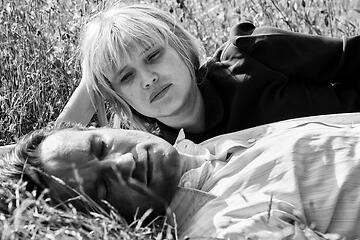
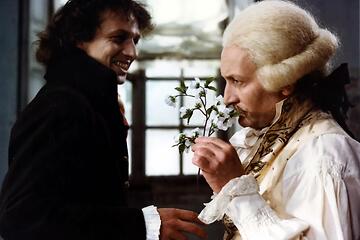
The film drama won the Silver Bear for Best Director at the 1994 Berlinale, with the leading roles played by the award-winning Julie Delpy (Homo Faber) and Zbigniew Zamachowski (The Pianist). Polish barber Karol (Zbigniew Zamachowski) meets Dominique (Julie Delpy), a Frenchwoman, in Budapest; they subsequently marry and move to Paris. Yet when she divorces him, he finds himself down-and-out on the streets of a foreign city, penniless and without a passport. A Polish compatriot, Mikołaj (Janusz Gajos), helps Karol return to Warsaw in a suitcase. Driven by the desire to take revenge on his ex-wife, the now successful businessman fakes his death with the intention of luring Dominique to Poland with hopes of inheriting his fortunes. With his Three Colours trilogy, Kieślowski thematically examined the three colours of the French tricolour. The films were made in 1993 and 1994; Kieślowski died two years later. The fact that one of the most renowned representatives of Polish cinema made reference, in his later works, to the values of the French Revolution - liberty, equality, fraternity – as a means of appraising contemporary life in France demonstrates once again how close many Polish artists, intellectuals, and dissidents felt to France. An affinity that is based on centuries-old relations between the two countries and yet does not preclude critical reflection – not out of bitterness, but as a continuation of the key concepts of the “cinema of moral unrest,” by means of which Polish film-makers exerted a significant influence on the European film landscape.
Text: Bernd Buder
Wed 05.11. I 16:30 I OBENKINO I original version with German subtitles
Krzysztof Kieslowski, Krzysztof Piesiewicz
Edward Kłosiński
Halina Dobrowolska, Claude Lenoir
Zbigniew Preisner
Zbigniew Zamachowski, Julie Delpy, Janusz Gajos, Jerzy Stuhr
Krzysztof Kieslowski -