WIELKI SZEF
THE BIG CHIEF
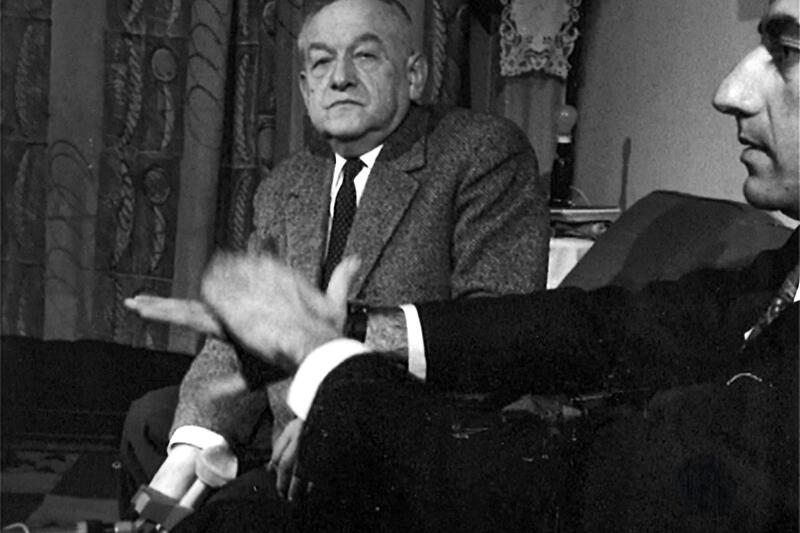
French journalist Jean-Pierre Elkabach interviewed the charismatic Jewish-communist political activist and agent in the early 1970s. The material was confiscated at the border and recently resurfaced in a Polish archive. This provides an opportunity to reflect on the life story of Trepper, an individual who faced extreme political pressure throughout his life: as a communist in the British Mandate of Palestine, after his escape to Moscow under Stalin, as a spy in Belgium and France, later again in the Soviet Union since the regime feared he would reveal details about how his warnings about Operation Barbarossa were ignored by Stalin in 1941, and finally in Poland in 1968. Tomasz Wolski assembles interview and archive footage into a gripping historical portrait, one in which the boundaries between right and wrong often blur. In doing so, he consistently links the case of Trepper, who for a time served as chairman of the Social and Cultural Association of Jews in Poland after the end of the war, with the anti-Semitic campaign of the Gomulka government in the aftermath of the Six-Day War, which led to the forced expulsion of 20,000 Jews from Poland in 1968. In 1972, a worldwide publicity campaign ensured Trepper was allowed to leave.
Reflecting on his film, the director says:„THE BIG CHIEF serves as a compelling narrative delving into the tumultuous and intricate era in which our parents and grandparents navigated. It paints a vivid portrait of a man thrust into the midst of adversity, compelled to make choices that, through the lens of contemporary understanding, defy easy judgment. Audiences will be presented with a historical figure who does not correspond to the notion of a conventional straightforward hero (if such a figure even exists), a man shrouded in enigma, harbouring his secrets, and perhaps even actively crafting the mysteries surrounding his persona. The events that took place in the 1970s are, on the one hand, a clear manifestation of human wickedness (anti--Semitism), and, on the other hand, an extraordinary demonstration of solidarity (the committee for the release of Trepper). […]
Striving to create the most cinematic, dramatically charged narrative possible, I refrained from a voice-over narration. However, I aim to guide the viewer through significant historical events through the way I edited the film. In the most accessible yet cinematic manner possible, I’m offering context in case the viewer lacks the necessary historical knowledge. Scenes of historical events are edited with their own tension and emotional drama. They aim to convey the atmosphere and reality of those profoundly turbulent times and occasionally remind us of their brutality. All of this is to show the stark reality and dangers that Trepper faced head-on.“
Text: Bernd Buder
Fri 07.11. I 18:45 I OBENKINO I original version with English subtitles
Tomasz Wolski
Tomasz Wolski
Aleksandra Landsmann, Igor Kazmirchuk
TVP, INA, Atoms & Void, KBF, MIK
Tomasz Wolski -